AI-powered skin analysis is reshaping aesthetic medicine by delivering objective diagnostics, personalised treatment planning, and measurable outcomes that enhance patient trust, compliance, and clinical precision
Artificial Intelligence (AI) is rapidly transforming industries, and the world of aesthetic practices is no exception. From diagnosing complex skin conditions to tailoring treatments that align perfectly with individual needs, AI-powered skin analysis is setting a new gold standard in dermatology and aesthetics. This innovative tool not only enhances assessment accuracy but also empowers practitioners and clients through informative analysis and targeted treatments, leading to greater patient compliance and satisfaction.
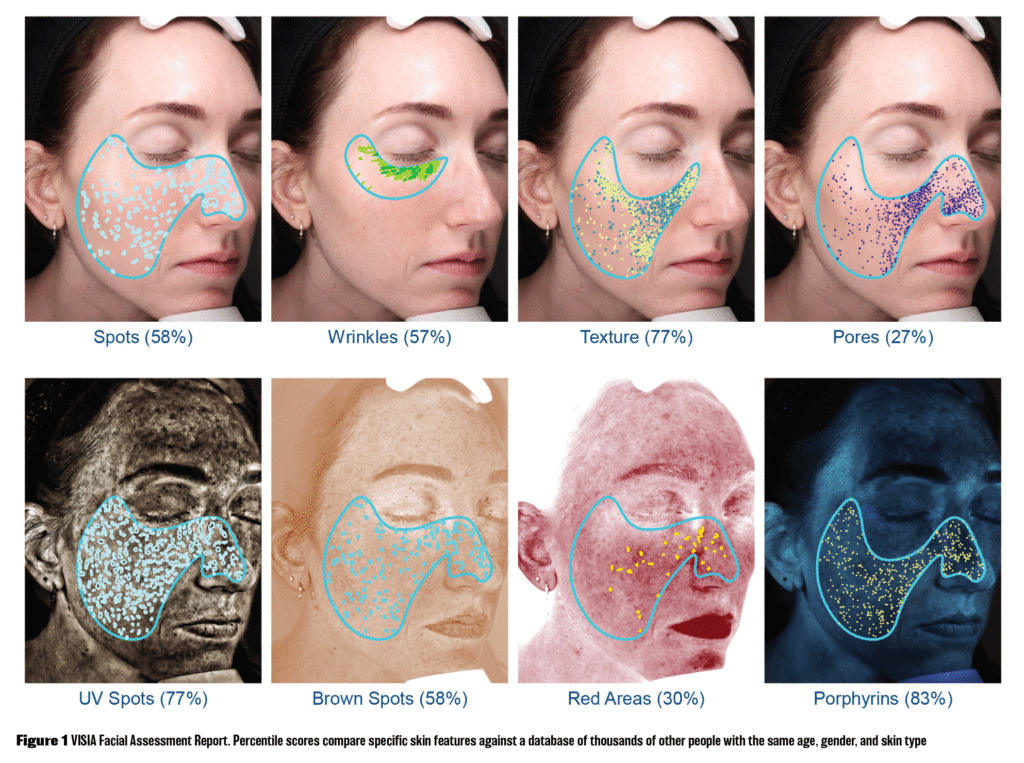
‘AI skin Analysis allows us to employ a multi-spectral imaging platform that measures eight key skin parameters: pigmentation, pore size, porphyrins, UV spots, photodamage, texture, wrinkles, and overall skin health,’ reported Paul W. Wallace, MD, MPA, owner of Wallace Skin and Body Institute (Ladera Heights, CA, USA). ‘AI generates an objective, reproducible baseline for each patient’s skin by capturing high-resolution, cross-polarised, and UV photographs. This data serves both diagnostic purposes (e.g., identifying subsurface hyperpigmentation or early photodamage) and patient education.’
Dr Wallace takes advantage of the technology to first establish a baseline for the patient’s skin and then to monitor treatment. ‘We perform follow-up scans after one or two treatments, depending on the treatment protocol, whether it’s a series of laser sessions, microneedling with growth factors, or a customised chemical peel regimen,’ he stated. ‘Comparing sequential data points allows us to assess quantitatively, as opposed to subjectively, whether pigmentation is fading, texture is smoothing, or inflammation markers (e.g., porphyrins indicating bacterial colonisation) are decreasing. We then adjust treatment parameters in real time, and tailor settings such as laser fluence or peel strength to each patient’s response curve.’
Dr Wallace explained that AI algorithms process raw imaging data that may include pixel intensity, spectral reflectance, and polarisation metrics, and compares the values against a database of peers to produce relative percentile rankings for each parameter. ‘If a patient’s wrinkle score is in the 80th percentile for her demographic, our system flags that collagen remodelling should be prioritised. Conversely, a high porphyrin count directs us toward antibacterial protocols or light-based therapies targeting P. acnes. We then layer in clinical history, Fitzpatrick skin type, prior treatments, and sensitivity to formulate a stepwise plan.’
‘The patient experience is markedly improved because clients receive a tangible, easy-to-understand report illustrating exactly which concerns exist beneath the surface, then watch those metrics improve,’ Dr Wallace continued. ‘That clarity drives adherence; patients feel directly involved in their treatment journey and often express increased trust knowing their regimen isn’t guesswork. Anecdotally, after integrating AI analysis, we have seen a 20% uptick in package purchases for combination protocols, as clients see the data and understand the rationale for layering therapies.’ He added that incorporating AI skin analysis has helped elevate his practice by positioning them as leaders in evidence-based cosmetic dermatology.
AI skin analysis excels in uncovering subtle skin issues that are often invisible to the naked eye, allowing providers to identify and address common skin concerns with greater precision. While traditional skin rejuvenation techniques often relied on broad-spectrum treatments like intense pulsed light (IPL) for generalised treatments, modern advancements now offer single-wavelength lasers tailored to specific skin conditions. By integrating AI skin analysis, providers can design highly targeted treatment plans from the outset, leading to greater patient satisfaction.
Enhancing patient understanding through visual data
Monica Bonakdar, MD, is a cosmetic dermatology specialist (Newport Beach, CA, USA) and incorporates AI skin analysis for patient education. ‘Having an AI tool that enhances the patient’s understanding of their current skin health and what their journey is going to look like has helped me stand out in my field,’ she reported. Dr Bonadkar noted that most patients have multiple issues that may require treatment for optimal results and uses her AI skin analysis to break down her patients’ concerns into more specific problems, such as visible spots from accumulated sun damage, wrinkles, texture changes, broken capillaries, and enlarged pores. ‘Once you break it down for them, they are more willing to sign up for a treatment plan that requires multiple modalities. For example, if I propose a treatment plan with a multi-laced station, I may use one treatment for surface browns, another to clean up telangiectasis, and then another to flush under the skin and improve texture. The skin analysis helps this make sense to the patient and understand why I am proposing a multi-layer laser treatment.’
AI skin analysis plays a pivotal role in attracting patients to aesthetic practices by offering a highly informative experience that resonates with modern consumer expectations. Patients are drawn to the technology’s ability to provide personalised insights into their skin health, often prompting inquiries and consultations based solely on the analysis itself. Additionally, AI-driven recommendations for specific skincare products may enhance the patient’s shopping experience, allowing brands and providers to create tailored solutions and track care results effectively to increase patient satisfaction and boost product sales, as consumers are more likely to purchase items when they see evidence-based outcomes and personalised care paths that align with their unique skin profiles.
Dr Bonakdar explained that incorporating this technology has enabled them to establish a baseline of the patients’ skin prior to treatments and monitor progress throughout treatment, allowing for personalised adjustments to each patient’s home skincare routine. She also provides an explanation sheet to her patients that explains each part of the skin diagnosis, which not only increases patient satisfaction but also allows her to monitor their skin for improved product recommendations.
Board-certified dermatologist Anny Xiao, MD, of Newport Cove Dermatology (Newport Beach, CA, USA) reported that AI skin analysis can detect UV spots beneath the skin’s surface that can appear where DNA damage has occurred. ‘Patients are always interested to see the invisible damage they have,’ she stated. ‘We often do fractional laser resurfacing to decrease a patient’s skin cancer risk1, and we can see the UV spots score improve through AI skin analysis, which is very reassuring for them. Another thing we see that is not always obvious is conditions like melasma or rosacea, because in certain cases it can be very subtle. When we analyse their skin, it can highlight the deeper pigmentation or deeper blood vessels that are not readily visible, which can really help guide our treatment recommendations, tailor the settings for our treatments, and guide us on what areas of the face we should focus on during the treatment.’
Dr Xiao’s VISIA (Canfield Scientific, Inc.; Parsippany, NJ, USA) device also allows her to prioritise aesthetic treatments for her patients. ‘We often choose a skin concern that will show improvement right away, which encourages them to continue maintenance and other treatment recommendations. I believe it increases patient satisfaction because they feel like their treatment was worth it.’ She mentioned that they only offer before and after AI skin analysis photos due to skin changes throughout treatments.
Product development and accelerated R&D
According to Helen He, China General Manager for PerfectCorp AI facial technology (New Taipei City, Taiwan), the AI-Powered workflow boosts consultation productivity while accelerating consumer decision-making through simplified diagnostics. As AI skin analysis benefits both providers and clients, cloud batch analysis of users’ skin health status may help increase product development efficiency and accelerate product R&D. ‘For companies with rich product lines, AI skin analysis with product line recommendations can improve consumers’ shopping efficiency,’ Ms He reported. ‘For consumers who have already made purchases, brands or institutions can use online AI skin analysis services to track changes in consumer skin health, promote care plans in a timely manner, and increase consumer repurchase rates.’ According to the manufacturer, PerfectCorp’s AI facial technology delivers rapid assessments using portable smart devices; a frictionless process that drives consumer engagement by instantly addressing skin concerns online and enables providers to efficiently conduct preliminary assessments.
James Chao, MD, FACS, medical director of Image Spa MD (Encinitas, CA, USA), feels that AI skin analysis technology is still in its infancy but is growing rapidly. ‘Today’s skin analysis systems include both hardware-based systems and camera phone-based apps, or software-based. I think that because the hardware-based systems are very expensive, you cannot scale as fast as with the software systems,’ he said. ‘I frequently use imagery in the medspa side of my practice to demonstrate and document skin quality, showing clients before and after results. Now with AI, I can add a predictive element. Patients really enjoy the informational aspects, based on what they see in a series of photos during treatment. AI skin analysis has helped improve closure rates, as people can see their treatments are working and they have objective data that they can take with them and share with their friends.’
In Dr Chao’s opinion, even though the technology is new, the future of AI skin analysis holds an immense promise for reshaping the landscape of dermatology and aesthetics with advancements that are expected to incorporate even more sophisticated predictive algorithms and imaging techniques, enabling personalised treatment plans that cater to the unique needs of every patient. This progress will not only enhance clinical outcomes but also strengthen the connection between providers and patients through data-driven insights that empower individuals in their skincare journey. ‘If we look at this again in 6-9 months, we may see a whole different set of data because we are just at the inflection point on that curve,’ he added.
AI skin analysis has revolutionised dermatology and aesthetics, offering precision, patient education, and enhanced outcomes. From improving treatment efficacy to boosting consumer engagement and product innovation, this technology has become a cornerstone of modern skin care. As it progresses, its potential to integrate predictive tools and advanced imaging promises a transformative impact on both providers and patients alike, leaving the future of AI skin analysis with an exciting chapter yet to be written.
Written by Cindy Papp, contributing editor
References
- Benson TA, Hibler BP, Kotliar D, Avram M. Nonablative Fractional Laser Treatment Is Associated With a Decreased Risk of Subsequent Facial Keratinocyte Carcinoma Development. Dermatol Surg. 2023 Feb 1;49(2):149-154. doi: 10.1097/DSS.0000000000003672. Epub 2022 Dec 6. PMID: 36728065