
Mariam Tsivtsivadze, MD, explains how combining treatments offers customised, minimally invasive solutions for concerns such as eyebrow lifting, facial harmonisation, and asymmetry correction
In modern aesthetic medicine, achieving natural, harmonious, and long-lasting results requires more than a single approach. Nowadays, the most common combination treatment is a ‘Golden Triad’ approach that integrates modalities like threads, toxins, and fillers. It addresses multiple layers of ageing—restoring volume, improving skin quality, and providing structural support. This synergistic strategy ensures comprehensive rejuvenation and personalised outcomes tailored to each patient’s unique needs. As patient demand for minimally invasive procedures grows, the use of combination therapies continues to rise, offering solutions that balance efficacy, safety, and minimal downtime.
This article aims to highlight the importance of a combination approach for achieving optimal, long-lasting results across a range of patient needs. Many patients focus on a single concern, yet their conditions often require a multifaceted treatment plan for complete resolution. This article will discuss how to assess a patient and develop a personalised treatment strategy. The effectiveness of this combined approach will be demonstrated through three patient cases, each with different indications:
- Eyebrow lifting
- Full face harmonisation
- Correction of facial asymmetry.
The treatments discussed involve absorbable barbed threads (PLLA/CL), BoNTA (botulinum toxin A), and hyaluronic acid (HA) gel.
Patient assessments
Patients are evaluated based on their individual signs of ageing, personal desires, facial structural changes, muscular activity, skin laxity, and skin quality1. Anatomically, all facial layers are interconnected, meaning that treating one layer without considering the others can be insufficient. Therefore, a comprehensive, multi-layered approach is essential.
Eyebrow lifting is one of the most requested procedures, with patients often seeking elevation of the tail of the eyebrow. In the upper third of the face, bone structure, muscle activity, and soft tissue compartments play significant roles. Achieving a long-lasting effect requires combining multiple modalities, as a single approach (such as soft tissue repositioning with threads) may not be sufficient. The optimal result can be achieved with a combination of threads, toxins, and fillers, if necessary.
Materials and methods
The article reviews three cases with different indications where tailored treatment plans were developed. The results of each case are described below.
Case 1: Eyebrow lifting
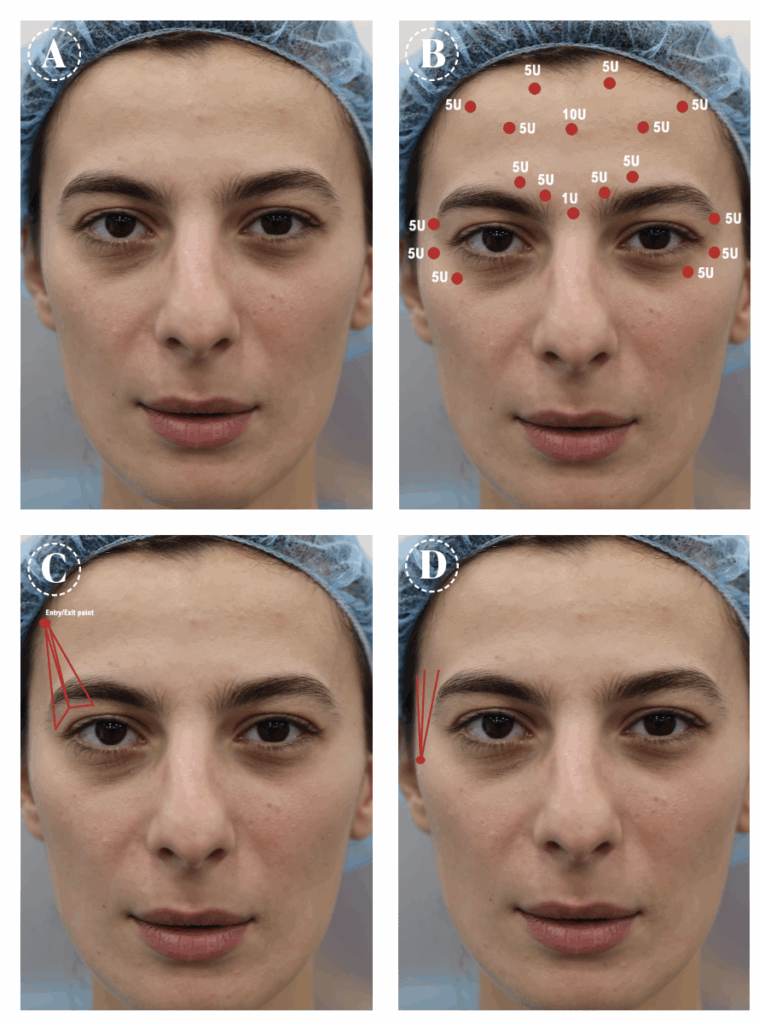
Patient: 32 years old, seeking eyebrow elevation and non-surgical canthopexy using threads (Figure 1A).
During an assessment, in the upper third of the face, high muscle activity was displayed: occipitofrontalis, temporalis, procerus, corrugator supercilii, and orbicularis oculi2. Therefore, due to the anatomical structure of the face, if threads are placed in the superficial fat compartments, the constant muscle contractions underneath could compromise thread fixation, which will cause the rapid loss of results, regardless of the type and method of thread implantation.
Treatment plan
In this particular case, the first step was an injection of 100U of Abo Botulinum toxin A (Figure 1B).
After 10 days from the BoNTA injection, absorbable bi-directional 50 cm barbed thread (PPLA/CL) was implanted into the subcutaneous fatty tissues. The lateral orbital compartment, ROOF, and middle forehead compartment were repositioned and fixed in an elevated position using threads. Furthermore, the lateral canthal tendon was elevated to a higher position, which changed the shape of the eye (Figure 1C).
Two weeks after the thread procedure, HA gel was injected into the temporal area (Figure 1D).
Results
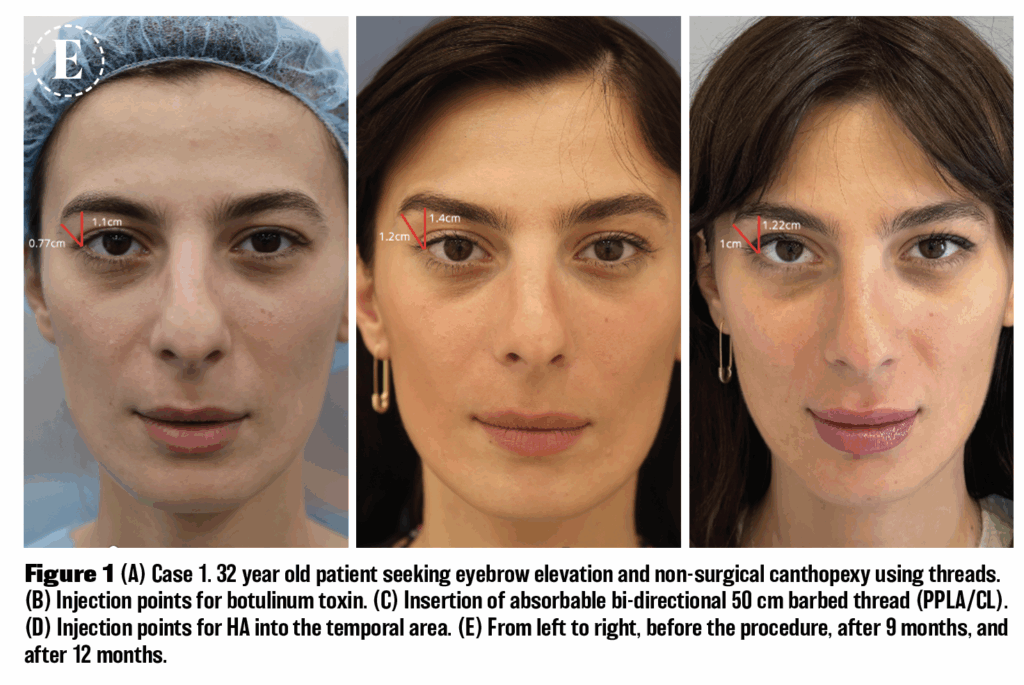
The shape of the eyebrow and eye were feminised and improved, with results maintained for over two years.
Before the procedure, the distance between the lateral canthus and the tail of the eyebrow was 0.77 cm; after 9 months, the distance was 1.2 cm, and after 1 year, it was 1 cm.
The measurement in a straight line from the lateral canthus to the eyebrow before the procedure was 1.1 cm; after 9 months, it was 1.4 cm; and after 1 year, it was 1.22 cm (Figure 1E).
Measurements indicated a consistent increase in the distance between the lateral canthus and eyebrow. The overall effect lifted the tail of the eyebrow, enhanced the eye shape, and increased the distance between the eyebrow and upper eyelid.
Case 2: Full-face harmonisation
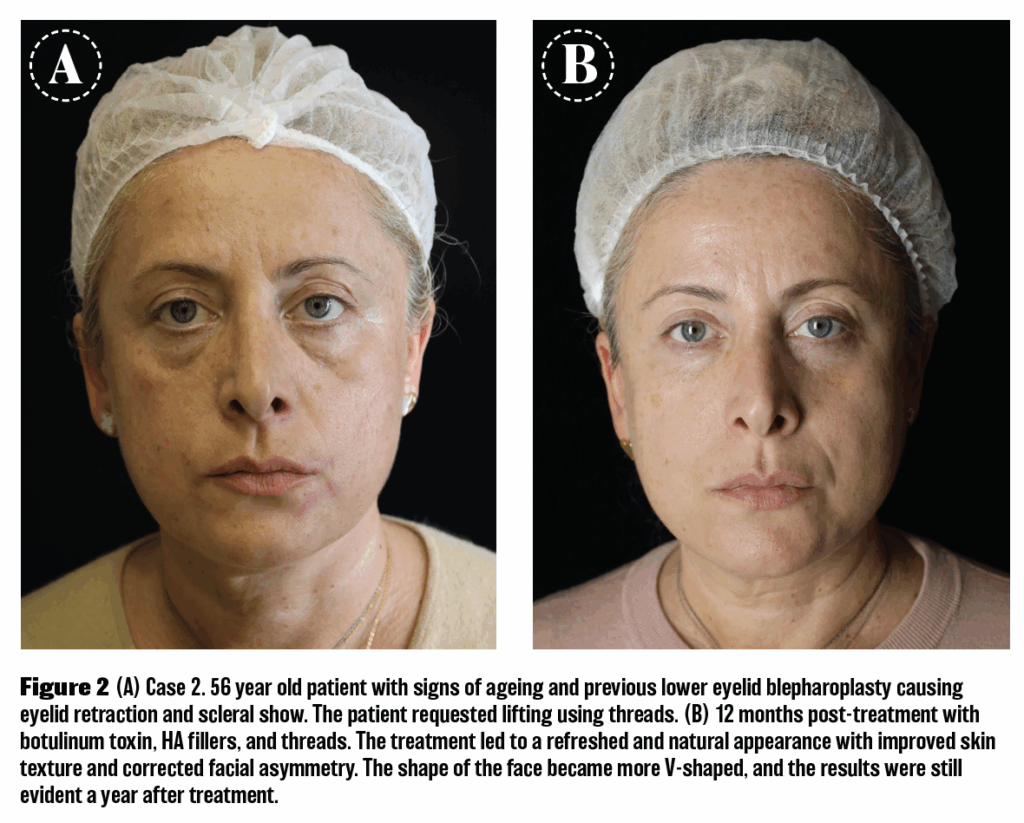
Patient: 56 years old, with signs of ageing and previous lower eyelid blepharoplasty causing eyelid retraction and scleral show. The patient requested lifting using threads (Figure 2A).
Patient assessment begins with an evaluation of the periorbital region, revealing expressed wrinkles around the eyes, scleral show along sunken eyelids and tear trough deformity.
This patient has a negative vector, which indicates volume deflation in the cheekbone area. Furthermore, marionette lines are expressed, disturbance of the jawline is observed, and mentalis muscle activity and asymmetry in the mental area are present.
For such indications, a single approach is not enough. To achieve an optimal result, a combination method is preferred.
Treatment plan
Botulinum toxin injection to the orbicularis oculi muscle (15 U per side) and mentalis (20 U).
HA filler injection to the pretarsal and preseptal areas (0.3 cc and 0.4 cc, respectively) to correct scleral show and retraction. A further 0.4 cc in the cheeks for volumisation and at the chin area to treat asymmetry.
Insertion of threads (absorbable multidirectional barbed threads) in the cheek and (absorbable smooth twisted threads) for the marionette lines, followed by repositioning of the jawline (absorbable bidirectional barbed thread) and correction of the oval shape of the face.
Results
The treatment led to a refreshed and natural appearance with improved skin texture and corrected facial asymmetry. The shape of the face became more V-shaped, and the results were still evident a year after treatment.
The result can be well observed after 1 year from the procedure, which indicates long-lasting results (Figure 2B).
Case 3: Correction of facial asymmetry
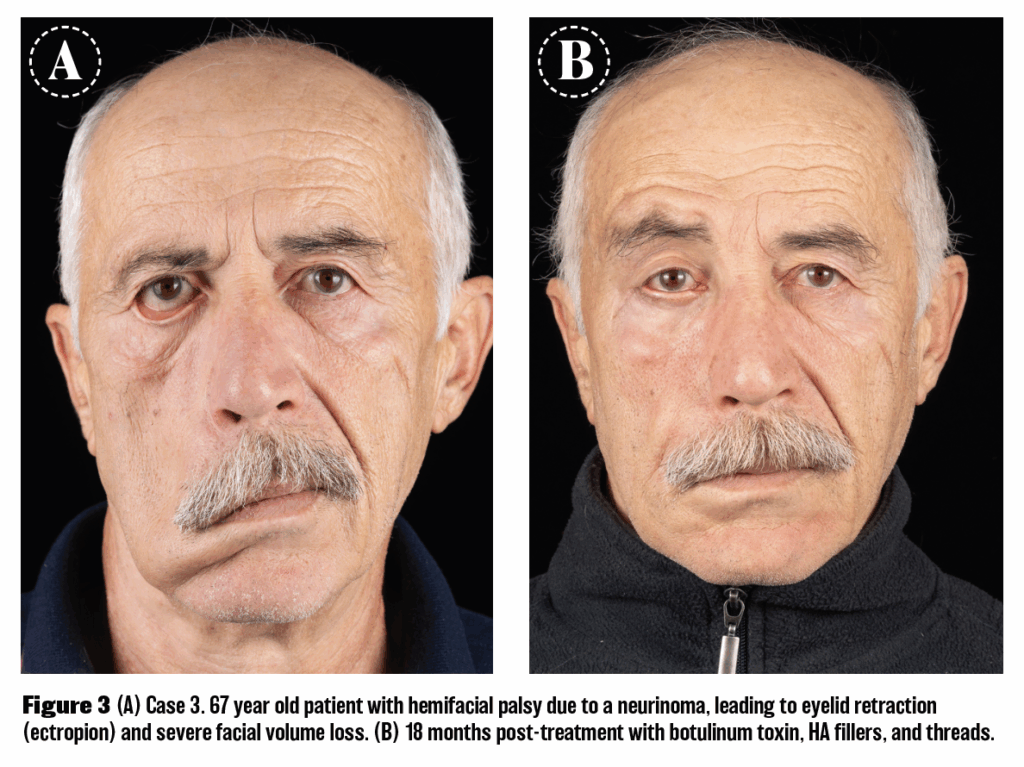
Patient: 67 years old, with hemifacial palsy due to a neurinoma, leading to eyelid retraction (ectropion) and severe facial volume loss (Figure 3A).
While assessing such a case, attention must be paid to eyebrow ptosis, which obstructs the patient’s vision, and ectropion, which, along with the aesthetic deformity, also causes dryness and irritation of the eye and can lead to loss of vision. Due to paresis, this patient has muscle and subcutaneous fatty tissue atrophy, which caused huge volume loss on the paralysed side of the face, extra skin laxity and inability to intake liquids without spilling.
In such cases, the mimic activity on the healthy side is overly active to compensate for the paralysed side of the face3. Due to the patient’s presented condition, a combination approach is required on the affected area of the face as well as on the healthy part.
The most effective combination of mini-invasive procedures for such a case is botulinum toxin injection and threads.
Treatment plan
On the paralysed side, the plan was as follows:
- Eyebrow lifting with non-absorbable polypropylene bidirectional barbed thread (500 mm). As a result, the eyebrow height was increased, which in turn increased the distance between the eyebrow and the eyelid margin. Consequently, the patient’s obstructed vision was improved
- Thread treatment for the cheeks, mouth corners, and lower third of the face with polypropylene bidirectional threads. The combination of these threads enabled the repositioning of soft tissues, fixation of the skin and soft tissues in the elevated position and armouring around the mouth, which fixed the issue of liquid spillage
- Further treatment with HA fillers, according to the principles of myomodulation, is instituted 1 month after threads and BoNTA in patients with the suitable selection criteria for the use of HA fillers.
It is imperative that injectors possess a deep understanding of agonist and antagonist muscle groups, as levators and depressors work in opposition for normal, balanced facial expressions.
The healthy side was primarily treated with BoNTA and indicated doses are for AbobotulinumtoxinA. Botulinum toxin injections were administered to the following muscles:
- Orbicularis oculi (OOM): 15 U
- Levator labii superioris alaeque nasi (LLSAN): 5 U
- Levator labii superioris: 5 U
- Nasalis: 3–4 U
- Zygomaticus major: 4–5 U
- Zygomaticus minor: 3 U
- Orbicularis oris (OO): 4 U
- Depressor anguli oris (DAO): 4–5 U
- Platysma: 6 U.
Treating contralateral, non-paralysed muscles in conjunction with ipsilateral paralysed muscles may result in long-lasting improvement of oral-ocular synkinesis; isolated ipsilateral injection generally causes only transient improvement. Fine, isolated muscle control on the paralysed side gradually improves with diminishing strength on the hyperdynamic side.
Results
To achieve symmetrical balance in patients with paresis, a complex treatment is required, especially when using minimally invasive methods. A result shown after 18 months was achieved by using non-absorbable threads once and botulinum toxin injections three times. Starting with high units is not advised on the healthy side, hence the procedure needs to be repeated several times. As you can see, after 18 months, symmetrical balance is achieved to the maximum level possible with a minimally invasive approach (Figure 3B).
Protocols for treatments using the ‘Golden Triad’ approach for other areas
Nose
Evaluate the depressor septi nasi, and if it is hyperdynamic, the first step is botulinum toxin injection, followed by insertion of threads for nose tip elevation and correction of the dorsum, or botulinum toxin injection, followed by HA filler injection4.
Jawline
To treat the jawline, botulinum toxin injections are required to the platysma, followed by threads to reposition the jowl compartment and HA filler injections to define the mandibular area.
Submental area
In the submental area, inject the platysma bands with botulinum toxin, followed by threads to correct skin laxity and reposition the subcutaneous fatty tissues.
Conclusions
The combination of threads, toxins, and fillers represents a combined strategy in minimally invasive aesthetic medicine, providing comprehensive and natural results that address the various indications of different patients. While threads offer tissue elevation and biostimulation, toxins effectively soften dynamic wrinkles by relaxing overactive muscles, and fillers restore lost volume and enhance facial contours5.
This integrated approach not only amplifies the individual benefits of each treatment modality but also creates a balanced and harmonious rejuvenation that is difficult to achieve with a single treatment alone. Moreover, by addressing multiple layers of the skin and underlying structures, the combination ensures long-lasting results, improved patient satisfaction, and a customisable treatment plan tailored to individual needs.
When implemented with evidence-based practices and a deep understanding of facial anatomy, the combination approach can minimise complications and recovery time while maximising outcomes. Its effectiveness lies in its ability to treat both static and dynamic aspects of facial ageing, making it an indispensable strategy in modern aesthetic medicine.
Declaration of interest None
References
- Smith, A. B., Robinson, J. L., Cooper, K. F., et al. (2023). Combination therapy for facial rejuvenation: Synergistic effects of threads, toxins, and fillers. Aesthetic Surgery Journal, 43(4), 534-542.
- Liu, M. C., Gupta, T. M., Johnson, P. H., et al. (2021). Botulinum toxin in the aesthetic treatment of facial wrinkles and lifting. Journal of Cosmetic Dermatology, 20(9), 2725-2733.
- Peterson, L. K., Moore, F. D., Becker, R. T., et al. (2022). Non-surgical approaches to correct facial asymmetry using dermal fillers and botulinum toxin: A review. Journal of Facial Plastic Surgery & Aesthetic Medicine, 24(3), 303-312.
- Brown, L. D., Silva, R. M., Harrison, K. P., et al. (2020). Use of hyaluronic acid in facial rejuvenation: Clinical review of indications and applications. Dermatologic Surgery, 46(10), 1400-1411.
- Hamilton, P. S., Fisher, K. L., Collins, M. A., et al. (2019). Combining botulinum toxin, hyaluronic acid, and threads in facial aesthetic rejuvenation: A review. Plastic and Reconstructive Surgery, 143(1), 12-20.