Women suffering from symptoms related to menopause want to be heard. How can aesthetic providers effectively help with hot flashes, weight gain, and other related concerns? We asked three menopause experts about how best to care for women navigating the change
Menopause has become big business and the topic of conversation. ‘There’s a $600 billion opening for businesses, [according to a report by Female Founders Fund], based on an average $2,000 a year that the 1 billion women expected to be in menopause worldwide by 2025 spend on prescriptions, doctor visits, treatments, devices, and products to address symptoms like night sweats, loss of libido, fatigue, and difficulty concentrating,’ as reported in a 2020 Forbes magazine article1.
Pharmaceutical manufacturers, entrepreneurs and femtech founders alike have responded with therapies that aim to make what can be decades of torture in a woman’s life more tolerable.
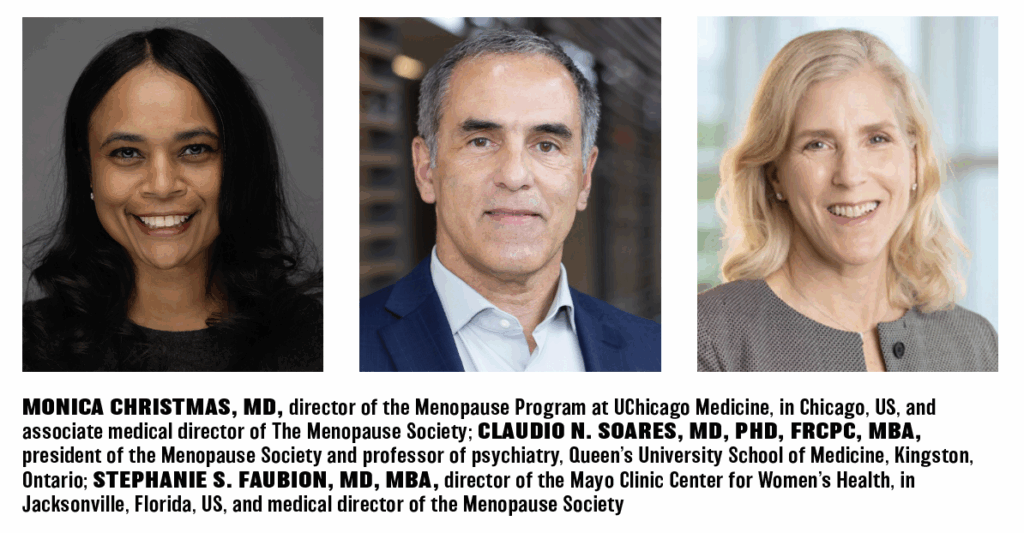
All the attention has been a long time coming, but like many physicians who have devoted their careers to menopause medicine, Monica Christmas, MD, is concerned about the lack of standards in treatment, misconceptions and unproven claims.
‘I think there are a lot of people that are doing things that are not evidence-based,’ says Dr Christmas, director of the Menopause Program at UChicago Medicine, in Chicago, US, and associate medical director of The Menopause Society.
Common misconceptions
For example, many don’t realise that there is no typical menopause patient. Menopause symptoms can happen in one’s 30s or early 40s, with some experiencing an onslaught of symptoms and others barely a hot flash.
‘There’s no one-size-fits all for symptoms and there’s no one-size-fits all for treatments,’ says Claudio N. Soares, MD, PhD, FRCPC, MBA, president of the Menopause Society and professor of psychiatry, Queen’s University School of Medicine, Kingston, Ontario.
Dr Soares explains, ‘It’s an opportunity if [clinicians] are in aesthetics, to get to know their clients well — to really have the opportunity to identify if something is bothering them, what exactly is bothering them, and how they can help.’
Following the science
Hormone therapy is likely the most effective evidence-based therapy for management of menopause symptoms, including hot flashes, night sweats, sleep disturbances, mood disturbances and more, according to Stephanie S. Faubion, MD, MBA, director of the Mayo Clinic Center for Women’s Health, in Jacksonville, Florida, US, and medical director of the Menopause Society.
But the hormone therapy used for menopause symptoms is not ‘hormone replacement,’ she says.
‘…we are not trying to replace what the ovaries used to make. This is an important distinction. We use much lower doses to treat menopause symptoms,’ Dr Faubion says.
Compounded bioidentical hormones are almost never needed due to the availability of bioidentical hormones approved by the US Food and Drug Administration (FDA) and other global governmental agencies. Regulated hormone therapy is examined for purity, potency, efficacy and safety. In the US, that means that what is in the bottle has to be between 90% and 110% of what is actually on the label, which is not the case for unregulated compounded hormone therapy, Dr Faubion says.
Safety monitoring also is not as robust with compounded hormone therapy as with regulated hormone therapy, she adds. ‘To be clear, the term bioidentical means identical to what your body used to make, so what we’re talking about here is oestrogel for the oestrogen and progesterone for the progestogen and those are readily available in government-approved products,’ Dr Faubion says.
In addition to the treatment of vasomotor symptoms from menopause, indications include moderate to severe genitourinary symptoms, prevention of osteoporosis, and treatment of women who go through premature menopause (before age 40). There can be downstream benefits, such as better sleep for a woman who has fewer hot flashes. But the therapy is not indicated for such things as sleep quality, weight loss, wrinkling or thinning skin.
‘Prescribing hormonal therapy in the hopes that it’s going to make somebody look younger is not an indication,’ Dr Christmas says.
The best time to prescribe it is usually in the first 10 years of menopause or before the age of 60, according to Dr Soares.
‘This is when oestrogen or hormonal therapy, in general, the benefits outweigh the risks,’ Dr Soares says. ‘If you’re in menopause for more than 10 years or are in your mid to late 60s, that’s probably not the best time or right time to start using oestrogen.’
In fact, for people who are over the age of 60 or more than 10 years from the onset of menopause, there’s evidence that being on hormone therapy has a higher associated risk of cognitive decline, according to Dr Christmas.
‘For women who are not good candidates for hormone therapy because of contraindications (e.g., oestrogen-dependent cancers or cardiovascular disease) or personal preference, it is important for healthcare professionals to be well informed about nonhormone treatment options for reducing vasomotor symptoms that are supported by the evidence,’ according to the 2023 nonhormone therapy position statement of The North American Menopause Society, published in Menopause2.
Among the treatments and therapies that have been shown to help some symptoms, according to the position statement, are cognitive-behavioural therapy, clinical hypnosis, selective serotonin reuptake inhibitors/serotonin-norepinephrine reuptake inhibitors, gabapentin, fezolinetant, oxybutynin, and weight loss.
There is a distinction, however, between outcomes from hormonal therapy and nonhormonal options, according to Dr Christmas.
‘With hormone therapy, we can get about 80% or more reduction of hot flashes and night sweats. Oxybutynin, a medicine for overactive bladder, has been shown to have about a 70% reduction in hot flashes and night sweats. Other nonhormonal therapy options are between 40% to 65% reduction in hot flashes and night sweats,’ she says.
Is menopause a good time to start weight loss meds?
The value of weight loss drugs during menopause, when some women gain weight, is an interesting question, according to Dr Faubion.
Studies suggest weight loss is associated with a reduction of hot flashes.
‘The Women’s Health Initiative observational study3,4 showed that weight loss was associated with improvement in hot flashes,’ Dr. Faubion says. ‘Our team just received funding to study terzeptide for hot flashes, so there will be more on that topic coming soon.’
Over-the-counter supplements
There are no over-the-counter supplements that have been shown to be effective for menopause symptom management, according to Faubion, who points to the nonprofit watchdog group Truth in Advertising.org/, which sent letters to 100 menopause supplement companies5 urging them to review what could be deceptive marketing with claims the supplements treat a variety of menopausal symptoms without the necessary scientific substantiation required by US governmental agencies.
Wearables
Wearables might help, depending on what one is trying to monitor.
‘Hot flashes are hard to monitor with wearable devices. Part of that is because they are measuring skin conductance changes, and these are not thought to be terribly accurate yet in women of colour,’ Dr Faubion says.
Apps or wearables that monitor healthy habits, like physical activity or sleep, could help with positive reinforcement, Dr Soares reasons.
And if a cooling device helps a woman to feel better during a hot flash, why not, the doctors say.
Lifestyle Rules
Commonsense lifestyle factors can make significant improvements in women’s quality of life before and during menopause.
Dr Soares encourages clinicians caring for these patients to look at healthy sleeping, dietary and physical activity, which have been shown to protect against many chronic problems, including depressive symptoms and anxiety.
Getting regular moderate to intense exercise is especially powerful, and providers shouldn’t shy away from educating women about the benefits of meeting physical activity goals.
‘When people know there is evidence6, they might put in some effort,’ Dr Soares says.
Things like modifying alcohol, caffeine, sugar, as well as weight loss, have been shown to help with sweats and mood, Dr Christmas adds.
Written by Lisette Hilton, contributing editor
References
- Emma Hinchliffe. Menopause is a $600 billion opportunity, report finds [Internet]. Fortune. October 26, 2020. Available from: https://fortune.com/2020/10/26/menopause-startups-female-founders-fund-report/
- “The 2023 Nonhormone Therapy Position Statement of The North American Menopause Society” Advisory Panel. The 2023 nonhormone therapy position statement of The North American Menopause Society. Menopause. 2023 Jun 1;30(6):573-590. doi: 10.1097/GME.0000000000002200. PMID: 37252752.
- Kroenke CH, Caan BJ, Stefanick ML, Anderson G, Brzyski R, Johnson KC, LeBlanc E, Lee C, La Croix AZ, Park HL, Sims ST, Vitolins M, Wallace R. Effects of a dietary intervention and weight change on vasomotor symptoms in the Women’s Health Initiative. Menopause. 2012 Sep;19(9):980-8. doi: 10.1097/gme.0b013e31824f606e. PMID: 22781782; PMCID: PMC3428489.
- Huang AJ, Subak LL, Wing R, et al. An intensive behavioral weight loss intervention and hot flushes in women. Arch Intern Med. 2011;170:1161–7. doi: 10.1001/archinternmed.2010.162.
- truthinadvertising.org (TINA.org). Menopause Supplements. truthinadvertising.org (TINA.org). October 2024.
- Yue, H., Yang, Y., Xie, F. et al. Effects of physical activity on depressive and anxiety symptoms of women in the menopausal transition and menopause: a comprehensive systematic review and meta-analysis of randomised controlled trials. Int J Behav Nutr Phys Act 22, 13 (2025). https://doi.org/10.1186/s12966-025-01712-z