


Stephanie Young, MD, and Edmond Lau, MD, discuss the clinical evidence and practical considerations behind using hybrid PDLLA–HA for tear trough rejuvenation
The tear trough remains one of the most technically demanding areas in aesthetic medicine. While patients increasingly seek natural under-eye rejuvenation, clinicians continue to face the challenge of achieving predictable improvement without oedema, contour irregularities, or prolonged downtime. Could a regenerative approach offer a new solution? In this article, Dr Stephanie Young and Dr Edmond Lau share the scientific rationale, clinical evidence, and practical experience behind the use of hybrid PDLLA–HA (JUVELOOK, VAIM, South Korea) for tear trough rejuvenation.
Understanding tear trough ageing and clinical challenges
The tear trough is one of the most common yet challenging aesthetic concerns due to the delicate anatomy of the periorbital region. Age-related skin thinning, volume loss, ligament laxity, bone resorption, and fat protrusion contribute to a tired, hollow appearance, while the thin skin and complex vascular anatomy increase the risks of oedema, contour irregularities, and the Tyndall effect. Although collagen-stimulating biostimulators have traditionally been avoided due to concerns about nodules and granulomas, emerging regenerative technologies, such as hybrid PDLLA–HA, are challenging this conventional thinking.
Why JUVELOOK? A regenerative approach for tear trough rejuvenation
JUVELOOK combines 20–40 μm PDLLA microspheres with non-crosslinked hyaluronic acid (HA), enabling smooth tissue integration, immediate hydration, and structural support in the delicate tear trough region. Beyond its favourable physical characteristics, its bio-interactive mechanism stimulates collagen and elastin production, extracellular matrix remodelling, angiogenesis, and adipogenesis, providing a regenerative approach that improves skin quality and restores structural support rather than simply replacing lost volume.
Clinical evidence and treatment outcomes
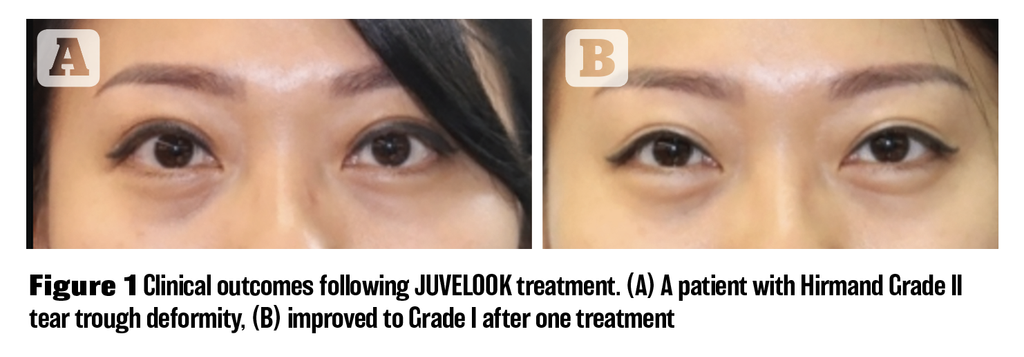
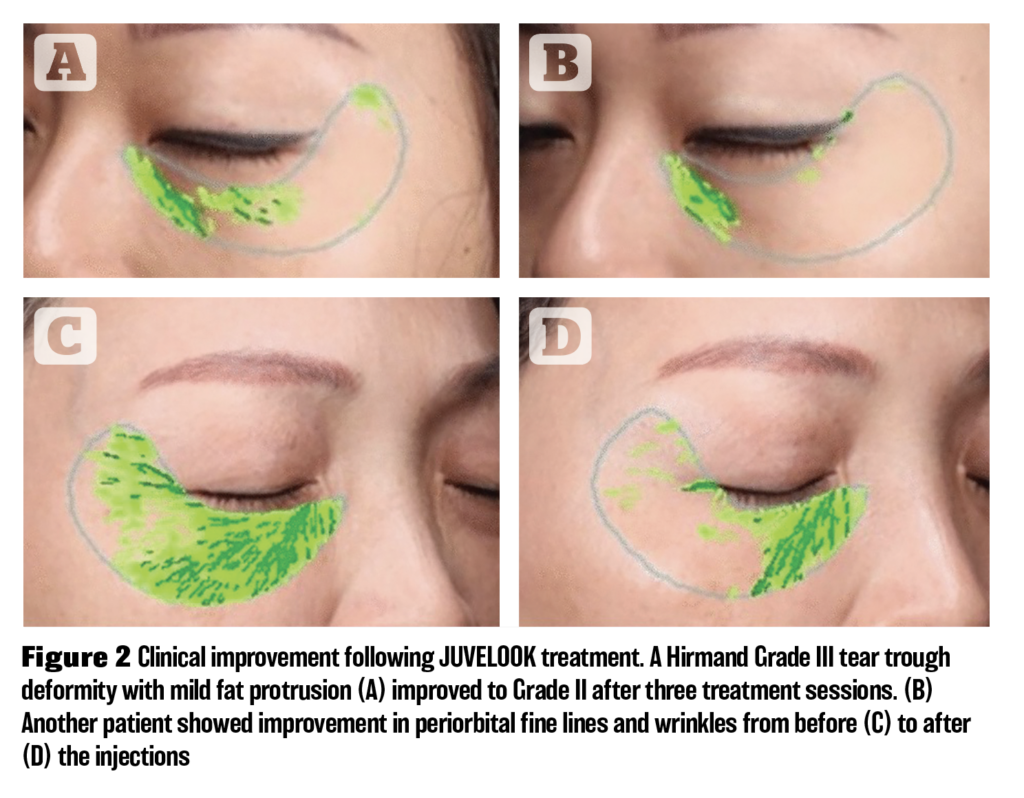
A multicentre prospective cohort study involving 15 women with Hirmand Class I–III tear-trough deformities demonstrated progressive improvement following three monthly JUVELOOK treatments.1 Both investigator- and patient-reported GAIS scores improved, accompanied by significant improvements in lower eyelid skin elasticity, hydration, skin quality, and radiance (p<0.001). All patients were willing to repeat the treatment, while only mild transient swelling was observed, with no nodules, granulomas, or other serious treatment-related adverse events reported.1
What the experts say:
Q1. Which patients are best suited for JUVELOOK tear trough treatment, and what feedback have you received?
Dr Stephanie Young
I believe the best candidates for JUVELOOK tear trough treatment are patients seeking an effective in-clinic procedure to treat tear trough deformity, under-eye dark circles, or periorbital fine lines. That being said, I do feel most patients will benefit from periorbital JUVELOOK treatment, as the periorbital skin is among the thinnest in the body and one of the earliest areas to show signs of ageing.
Dr Edmond Lau
The ideal candidates for JUVELOOK tear trough treatment are individuals with thin periorbital skin, mild tear trough deformity, and early signs of cutaneous ageing, rather than those with significant volume deficiency or advanced skin laxity. As JUVELOOK is a regenerative biostimulatory injectable, patients should be counselled that clinical improvement occurs progressively over several weeks to months as neocollagenesis and extracellular matrix remodelling take place. Consequently, individuals seeking immediate volumisation may be less suitable candidates, and failure to establish appropriate expectations may result in dissatisfaction.
When administered to appropriately selected patients, JUVELOOK provides a gradual, natural-looking improvement of the tear trough. In addition to reducing fine lines and improving skin texture, it offers subtle volume enhancement and promotes overall skin rejuvenation, including improvements in pigmentation, luminosity, and elasticity. These regenerative effects contribute to high patient satisfaction by restoring the periorbital region without the overfilled appearance often associated with conventional volumising fillers.
Q2. What are your key safety pearls and practical tips for clinicians performing JUVELOOK treatment in the tear trough?
Dr Stephanie Young
I always believe in being conservative in the unforgiving periorbital region. Always err on the side of undercorrection rather than overcorrection. It is always easier to touch up than to correct an overfilled patient. Always use a cannula (27 or 25G) to inject JUVELOOK in the tear trough. Do not use a sharp needle or inject in boluses. Inject slowly and with low pressure to avoid large bolus injections at any point. Inject in the right planes.
Dr Edmond Lau
Meticulous injection technique is essential when performing JUVELOOK treatment in the tear trough area due to the delicate anatomy and thin periorbital skin. The product should be distributed evenly to minimise the risk of focal accumulation and contour irregularities. A cannula is generally preferred to facilitate smooth, uniform placement while reducing tissue trauma. JUVELOOK should be deposited within the subcutaneous plane, superficial to the orbicularis oculi muscle.
In patients with concomitant medial cheek volume deficiency, additional product may be placed within the medial sub-orbicularis oculi fat (SOOF) compartment using a cannula to provide structural support to the tear trough and optimise the overall aesthetic outcome.
Only the 50 mg PDLLA-HA formulation (JUVELOOK) is recommended for treatment of the periorbital region because of its smaller particle size and more favourable safety profile in this anatomically sensitive area. To minimise the risk of adverse events, the injection volume should generally be limited to less than 1 mL per side per treatment session. Rather than administering excessive volumes during a single treatment, a staged approach with repeat sessions at 4–6-week intervals is recommended to achieve gradual and predictable clinical improvement.
The use of the 200 mg PDLLA-HA formulation (LENISNA / JUVELOOK Volume), even when hyperdiluted, should be avoided in the tear trough. Its larger particle size is associated with an increased risk of product aggregation and palpable or visible nodule formation, making it unsuitable for this delicate anatomical region.
Looking ahead
As aesthetic medicine shifts from simple volume replacement toward true tissue regeneration, hybrid PDLLA-HA offers a promising new approach for one of the face’s most challenging treatment areas. With encouraging clinical evidence, a favourable safety profile, and growing expert experience, JUVELOOK may help redefine the future of tear trough rejuvenation. To learn more about treatment protocols and expert injection techniques, join the JUVELOOK International Academy (JULIA) for comprehensive clinical education and practical guidance.
Find out more at: juvelook.com
References:
- Young SM, Lau EKH. Hybrid Biostimulator and Hyaluronic Acid Injectable for Tear Trough Rejuvenation. Aesthetic Plast Surg. 2026 May 7. doi: 10.1007/s00266-026-05817-z. Epub ahead of print. PMID: 42098500.


