

Supply and demand
When calculating the cost of performing a procedure, consider all related expenses including materials, supplies, staff time, marketing, follow-ups and associated overhead costs. Factor in the profit margin you are seeking to determine whether you are able to charge a higher price by distinguishing your practice with exclusively tailored offerings. Take into consideration where you are in practice when calculating your hourly rate. If you are just starting out, you may be willing to charge lower fees to gain experience and get exposure to new patients. However, if you have been in private practice for 15 years, you are already well established in your field and should be more selective.
Supply and demand also plays an important role in your local market and pricing considerations. If you are in an area like the Upper East Side of Manhattan, where there are hundreds of doctors offering almost identical services in a 1‑mile radius, you have to pay attention to the highs and lows of the laws of supply and demand. If you are marketing a high‑supply, high-demand product, for example, incorporate this factor into your pricing and charge a more competitive price. However, if you are operating in a high-supply, low-demand market in which there are more practitioners offering the services you offer and not enough patients to fill their waiting rooms, a price adjustment may be in order. The ideal situation is to be in a low-supply, high‑demand market, but these are exceedingly rare today.
 Review your local market to identify the procedures that are most popular among consumers and which may be enjoying a growth spurt. For example, if skin tightening devices are the top-selling treatments in your area, consider adding this service to appeal to a broader segment of consumers. If big-ticket procedures are still in a major slump, such as full-face ablative fractional resurfacing or laser lipolysis, offer some less expensive treatments to encourage patients to come in. If there are many clinics in your area that are marketing fat reduction systems, it may be a good idea to evaluate whether you should include one of these technologies in your service offerings to capture some of the market share that you may be losing to the competition.
Customer feedback
Use feedback from your customers as a critical tool to determine an ideal pricing structure for your practice. For example, if your staff receives call after call asking about the price of injectables or laser treatments, but callers do not book an appointment on hearing the range of fees quoted, this is a prime indication that your prices are higher than your community is willing to pay. Speaking with patients directly, or conducting a survey to determine how they feel about the value of your products or services, can also provide valuable insights. You can also solicit input on what services or products they would be interested in to further narrow any gaps.
Slashing prices is a bad policy and will end up backfiring in the long term. It may be necessary to lower your pricing to be more competitive and encourage higher procedure volumes in the short term; however, running a campaign for ‘50% off every laser procedure’, and ‘£5 per graft for hair restoration’ cheapens your practice and its standing in the community. People will think you are desperate and having a fire sale. If you run a special offer at a regular interval — such as the first Friday of every month, or every other month — you may be effectively lowering your fees for those services; patients will become savvy to the fact that there is a ‘deal’ in the pipeline and they will wait to visit until you have an offer.
By paying close attention to price versus value, you may be able to find more efficient ways to do business or identify areas in which you can reduce costs while improving the quality of your products and services. Whenever possible, stick with branded technology and products to market to your patients, even if the upfront costs are slightly higher. A plethora of generic products are flooding the market, especially in the EU coming in from Asia, and thus driving the pricing structure down even further.
 In some markets, it is common to see clinics market a device by brand name, when in fact, the device they have to offer is an off-price variation of a patented technology that has years of clinical research published to support its efficacy. The best example of this is the plethora of radiofrequency and fractional resurfacing systems on the market. The same practice holds true for fillers; there are dozens hyaluronic acid based fillers on the market, especially in Asia and Europe. Distinguish your clinic from the competition by marketing brand names of the products you offer so that consumers will not compare apples to oranges when reviewing fees.
Once a patient comes in for a visit, adding a secondary procedure or another area of treatment does not increase your cost of acquisition for that patient. If the patient is already in the chair, offering a second or third syringe at the same time (if the patient needs and wants it done) is practical and cost‑effective for both parties.
Bundling
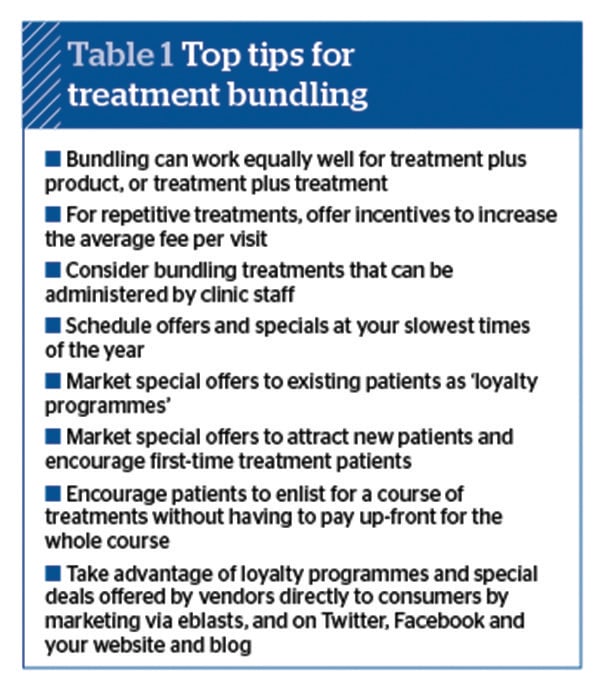
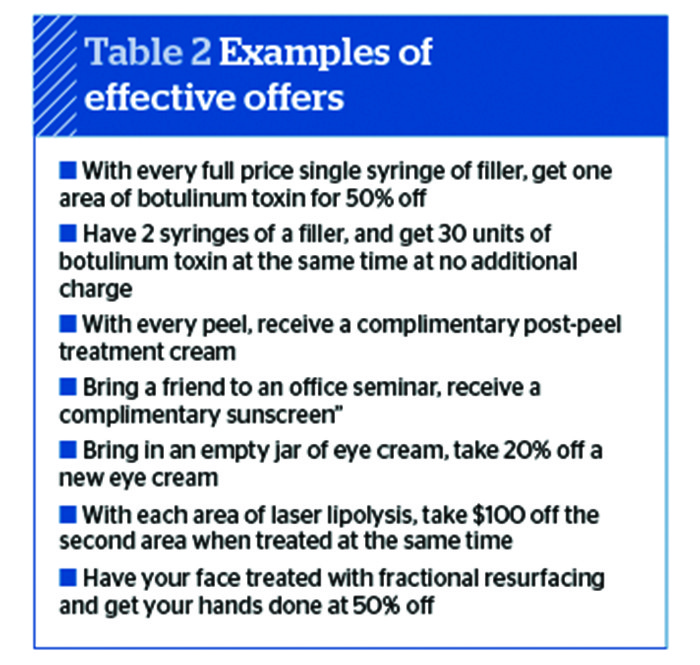
You can also be creative when bundling services. The most common methods are variations on ‘buy one, get one’, ‘buy one, get one half price’, and ‘three for two.’ Consumers are less inclined to lay out large sums far in advance so be wary of demanding that patients pay upfront for a series of repetitive treatments. Consider tweaking a common offer, for example: instead of ‘buy 4, get the 5th free’ try ‘after your 4th treatment, get the next one at no charge’. This allows patients to take advantage of a bonus treatment. Take your cues from retailers, hotels, restaurants, spas and salons. All service businesses today are faced with changes in how consumers spend their money and they have had to adjust their practices accordingly. Your patients may surprise you by showing their appreciation and loyalty if you are willing to demonstrate some sensitivity to their needs.
